
The Last Mile to the Machine: Why Barudan Builds the Iron and Lets Tracker Run the Road
Barudan America's Bob Stone and Thad Badowski on why a hardware company that makes some of the best embroidery machines in the world deliberately stays out of shop-management software — and what that means for decorators still moving jobs on USB sticks.
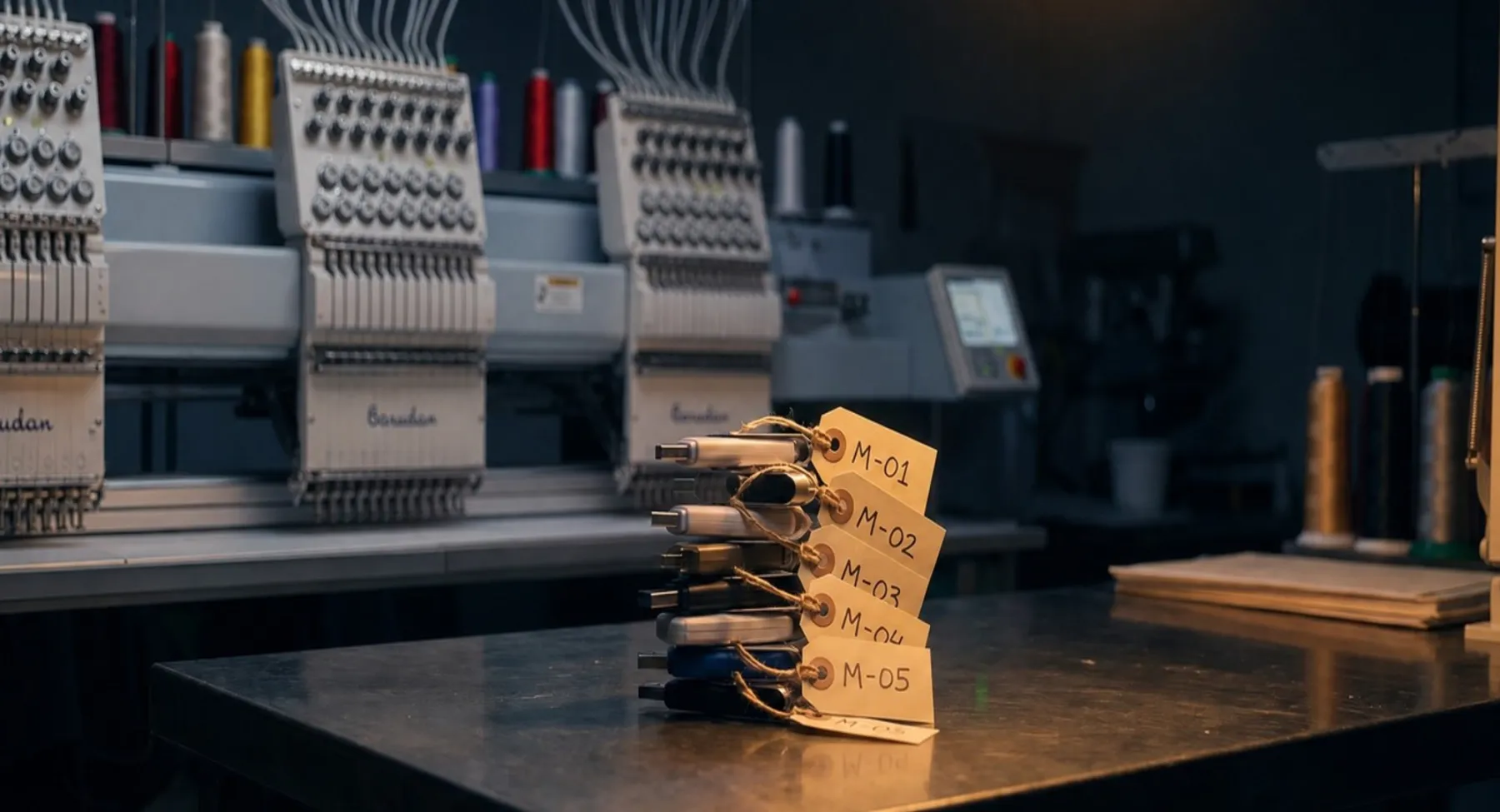
Modern embroidery machines stopped being the bottleneck years ago. What limits most shops is everything around the machine: getting the right design to the right head with the right thread, and knowing what happened once it got there. Barudan builds the machines and partners with Tracker for the workflow feeding them, rather than building shop-management software in-house. This piece explains why, in the words of Barudan America's VP of Sales and Chief Engineer.
There’s a ritual in embroidery shops that nobody romanticises. At the end of a long day, a shop owner loads tomorrow’s designs onto a stack of USB drives, one for each machine and operator. “It eats the evening. Sometimes it eats the night.” Thad Badowski, Chief Engineer at Barudan America, tells the story of one business owner who did it until three in the morning, slept three hours, and drove back at six to hand the drives to her first shift.
She wasn’t an outlier. By Bob Stone’s estimate, 75 to 80 percent of the industry still moves jobs this way.
“We had a nine-needle single head machine when I started in ‘94,” says Stone, Barudan America’s Vice President of Sales. “The best it would do was 750 stitches a minute, and that was really pushing it. Now machines sew faster, thread faster, colour-change faster. Everything’s designed for production.”
The iron, in other words, stopped being the bottleneck a long time ago. What’s left is everything around the iron: getting the right design to the right machine with the right thread, and knowing what happened once it got there.
That gap — between what modern embroidery machines can do and what shops actually let them do — is the story of one of the industry’s more quietly significant partnerships.
The Lamborghini Doesn’t Do Whiteboards
To understand why Barudan partners at all, you have to understand the company. Stone describes a philosophy inherited from founder Mr Yoshio Shibata, who never chased volume: “We’re not going the mass market producer, pushing out vehicles. We’re more like the Lamborghini — we make the absolute best machine we can.”
Barudan sits at number two in US units sold, and Stone is at peace with that. “Not everybody is going to own a Barudan. We understand that. But we do a great job selling every machine that we make.”
That obsession with the machine cuts both ways. It is why Barudan’s owners are famously loyal and most of the company’s business is repeat business. It is also why Barudan’s longest-running competitor is, in Badowski’s words, “our own old machines” — the company supports its equipment far longer than rivals do, so shops run decades-old heads happily and never come back for new ones.
But the same philosophy that makes the iron superb also kept Barudan, deliberately, out of software. “First and foremost, Barudan is a hardware company,” Stone says. Barudan’s own networking system, bNET — which evolved from its earlier LEM platform — handles design delivery to machines. Shop management was always someone else’s problem.
The trouble was that customers kept asking for it anyway.
The Epiphany
The partnership’s origin story starts, as these things do, with a customer. Badowski had been pushing Barudan Japan for an API, inspired by early attempts to automate a customer’s workflow from abroad. Then, at a trade event, a longtime Barudan customer raved about a shop-management program from England called Tracker. A conference call later, the pieces clicked: Barudan’s nascent API met a system built for exactly this job.
“It was the perfect opportunity to marry our API with the customer,” Badowski says.
“‘Why doesn’t Barudan do shop management?’ The answer is: we need to concentrate on sewing and embroidery, and let someone with more experience and expertise in that part of the industry deal with it. Mainly because they’re also dealing with the same artwork flow for DTF, DTG and screen printing.”
For Barudan US, the arithmetic was blunt. Building shop-management software in-house meant contending with a time-zone barrier, a priority barrier with developers in Japan, and a language barrier. Even more challenging was the variety of customer systems, and keeping up with those software changes.
The partnership “saved us a ton of time and development”, Badowski says — and spared both companies the finger-pointing that comes when a hardware maker and a software vendor are the same company and something breaks. Tracker’s integrations into SAP, Microsoft Dynamics and other ERP and warehouse systems sit on the customer’s side of the line, clearly maintained, clearly owned.
The Stigma You Can’t Hold in Your Hand
If the engineering case was clean, the cultural case was harder. Stone is direct about his industry: “It’s a very traditional industry. It’s like the old textile industry. They do it a particular way, and that’s the way they do it, and they don’t want to change.”
Tougher still, there’s a perceptual hurdle no ROI spreadsheet quite clears. “There’s a stigma tied to software because you can’t see it,” he says. “You invest a five-figure sum for an embroidery machine and you can see it right there. You can see the person running it. Software is much more challenging to understand and demonstrate value. So it needs the specialists to explain it and help customers understand what it can unlock in their business.”
Badowski sees a growth trap too often. “We see so many customers that start out with a handful of machines and they are not ready for their own success. They’ve bought three or four machines, and they’ve got inventory piled up on the floor and containers in the parking lot full of goods to be sewn. That’s the point where they’re ready for a system like Tracker.”
The economics sharpen as order sizes shrink — a trend Badowski watches closely. One major Pacific Northwest apparel brand, after installing bNET, ran the production reports and discovered it was putting two-head jobs on six- and eight-head machines, sewing a fraction of each machine’s capacity. They invested in two-head machines to handle the small runs.
When the average order drops, setup and changeover time becomes the tax that quietly kills throughput, and routing jobs efficiently stops being a luxury.
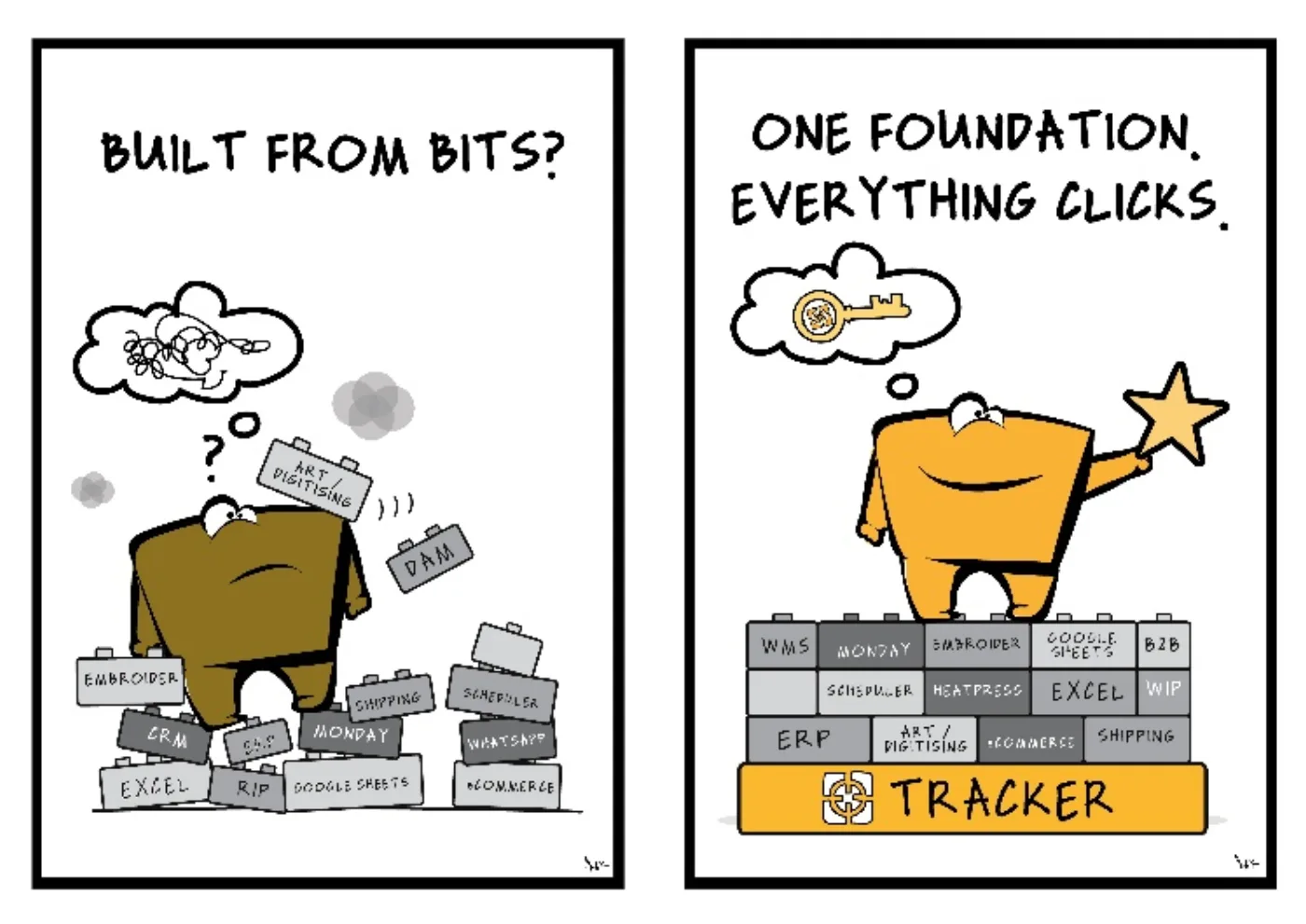
“It’s Changed Everything”
At a large sports licensing apparel manufacturer, the before-and-after is tangible. Production runs smoother, output is up and mistakes are down. The whiteboard era — orders tracked by hand, machines loaded by guesswork — is over.
“They know where their orders are in the process,” Stone says. “You can look and see, day to day, hour to hour, minute to minute, what you’re producing. You can see trends in order size, in colours. I don’t understand how anybody would not want to know that.”
The feature that gets the most jaw-drops in demos is also the simplest: colour management — pushing thread colours from a screen straight to the machine. On newer K-Series heads, and just as critically on older series machines with none of the built-in prompting, it closes the loop on the last manual step of setup. That matters doubly for mixed fleets, where Tracker is the equaliser between a brand-new head and a workhorse from another decade.
The transparency has a way of paying for itself in capital avoided. “Sometimes people add machines where they probably don’t need to,” Stone says, “because they are blocking up their capacity with the wrong jobs and so aren’t efficient.” A shop that can finally see its utilisation often finds capacity it didn’t know it had.
The Philosophy That Holds It Together
Ask Stone what the partnership is really for and the sales VP goes old-school on you. “I know it’s hokey, but it’s taking care of the customer,” he says. “We don’t have all the products they want in some instances, and that’s where Tracker comes in. I would hate to walk away from a customer saying, ‘We can’t help you.’ We always look to keep our customers satisfied.”
Badowski, the engineer who spent years arguing for the API before Tracker ever came calling, frames it as the removal of the industry’s last piece of copy-and-paste. “I appreciate all the work I’ve done with the Tracker leadership and the support team, helping show the world what you can do if you just bridge that last connection,” he says. “Keeping that line of communication open has been wonderful for us.”
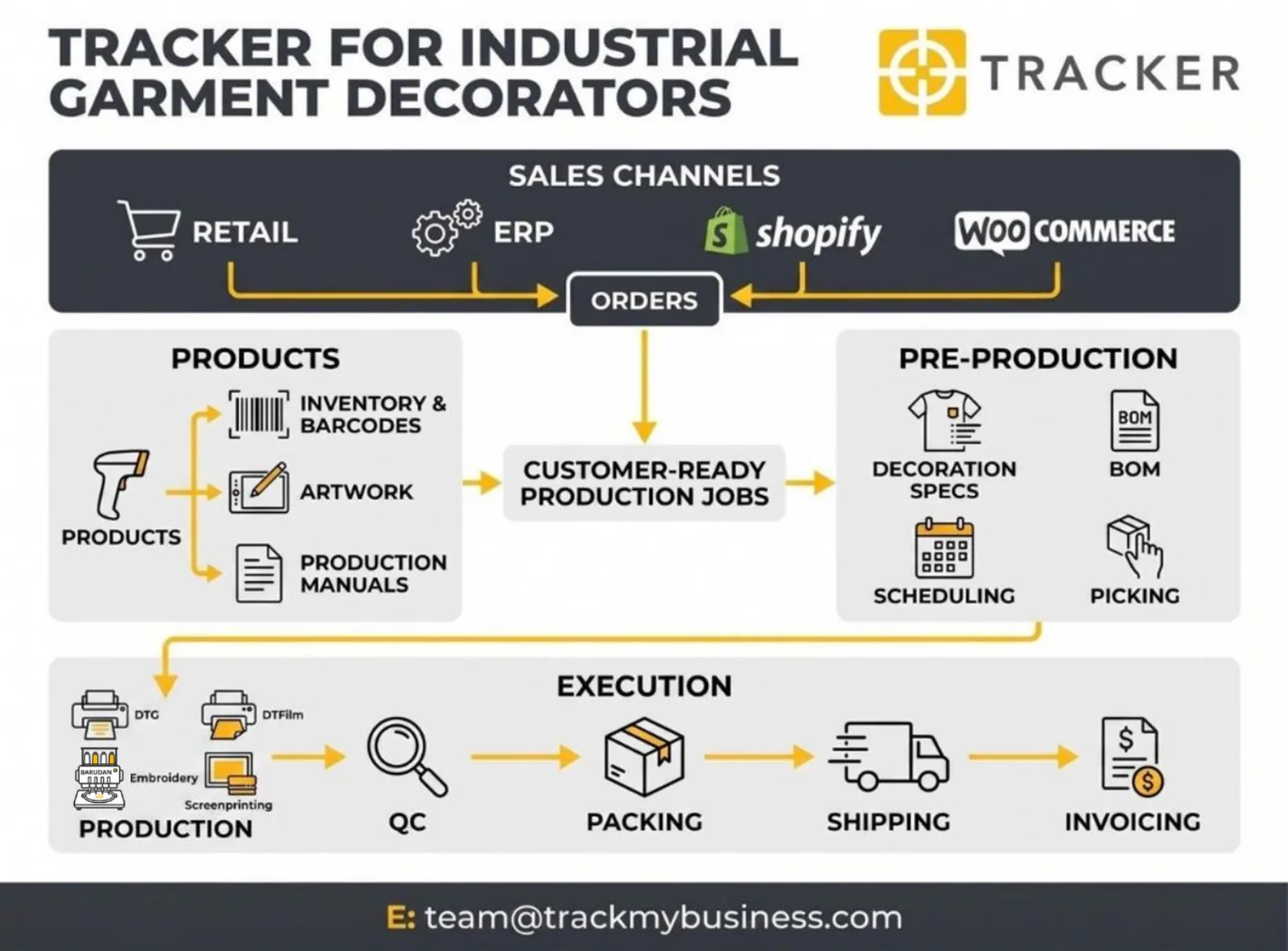
The moral for the decorated-apparel trade is a simple one, and the diagram above makes it visible: a great machine delivers its full value only when the workflow feeding it is just as good.
Barudan builds the Lamborghini. Tracker builds the road. And the shops that run both are the ones still standing at 6am — rested, with every job routed, every colour queued, and every head doing exactly what it was built to do.

Founder & Technical Director
Related Articles
Digital Proof Approvals + PLM Integration = Faster Licensed Team Gear Turnaround
How combining digital proof approvals with PLM distributor integrations accelerates licensed team gear production while maintaining compliance.
Read More
How Embroidery Shop Management Software Streamlines Production
Discover how embroidery shop management software helps manage orders, schedule jobs, track production and reduce delays across your embroidery shop.
Read More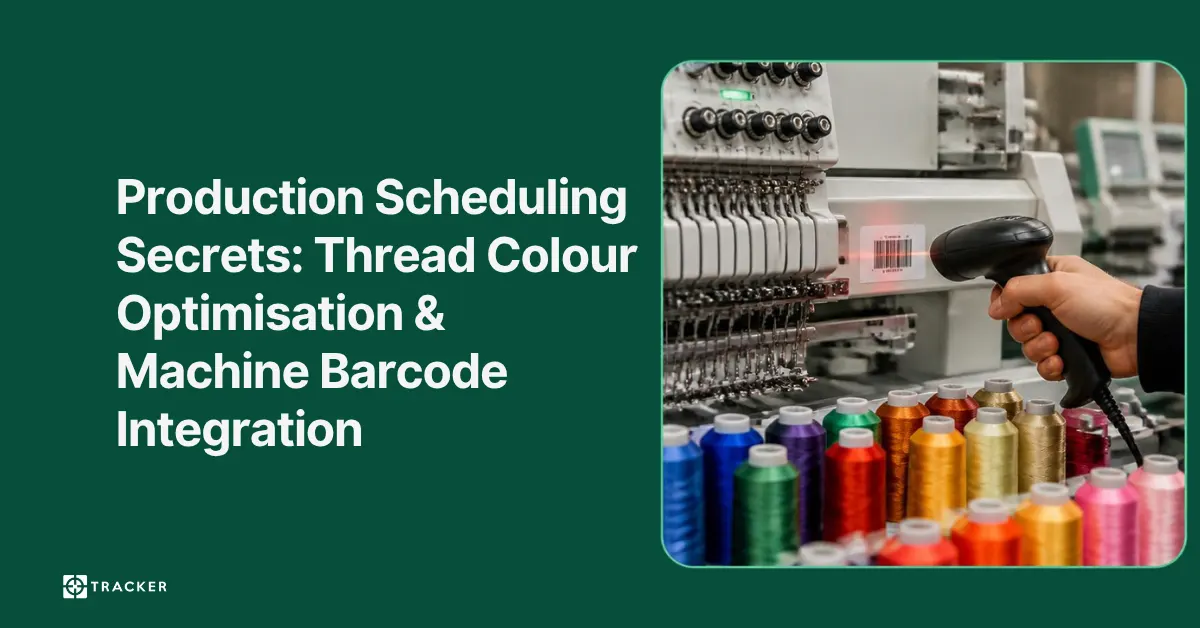
Production Scheduling Secrets: Thread Colour Optimisation & Machine Barcode Integration
Learn how thread colour batching and barcode-to-machine integration can increase your embroidery and DTG throughput by 30–40%.
Read MoreSubscribe to Our Newsletter
Get the latest articles, product updates, and workflow tips delivered straight to your inbox.
By subscribing, you agree to our Privacy Policy and consent to receive updates from our company.